Best of GMI · the ten canonical essays · 07 of 10
NEW FRAMEWORK · 2021
The Exponential Age.
After sixteen years, I am entirely changing my macro framework for the first time ever. The denominator has collapsed – and everything is about to change.
FROM THE GMI ARCHIVE · EXCERPT
EXCERPTED FROM THE GMI FEATURE ARTICLE:
MONTHLY PUBLICATION · APRIL 2021
FEATURE ARTICLE · GMI MONTHLY · APRIL 2021
The Exponential Age
This is an important GMI – maybe one of the most important GMIs ever.
Having used our macro framework for sixteen years, it is time to start transitioning to a new framework that will capture the biggest opportunities of our lifetime. With central banks changing the rules, suppressing the largest and most important asset classes, non-linear opportunities are created elsewhere. This makes me incredibly excited.
Something weird…
Something weird happened last year, and it took me a long time to process it. In the largest recession in 100 years – and in some cases, like the UK, in 250 years – the price of assets fell and then bounced really fast, catapulting in many cases to new highs, regardless of the underlying economic fundamentals. Every single cycle I have ever studied saw continued weakness and eventually a recovery over the subsequent eighteen months. The fact that the largest recession in history was an outlier seemed odd to me.
The macro narrative explaining this is, “Fed printing kept the system awash with liquidity and that has created a new bubble in all assets.” I have studied this Fed phenomenon for a while and never got comfortable with it. The transfer mechanism from QE to the markets just didn’t work in reality. Some mystery force was at play.
The lightbulb moment × 2
While thinking and cogitating repeatedly on this topic, I suddenly experienced a lightbulb moment that led to an even greater lightbulb episode – realising I had been missing the really big picture. Everything has changed, and most people are slow to even grasp this. And when I say everything, I mean everything.
I do not now think we are headed towards the macro disaster scenario. I think we crossed that Rubicon last year, and the actual outcomes will be wildly different to anything almost anyone is imagining.
I also don’t think we are in an asset bubble. What I am trying to say is that I am entirely changing my macro framework for the first time ever.
The black hole
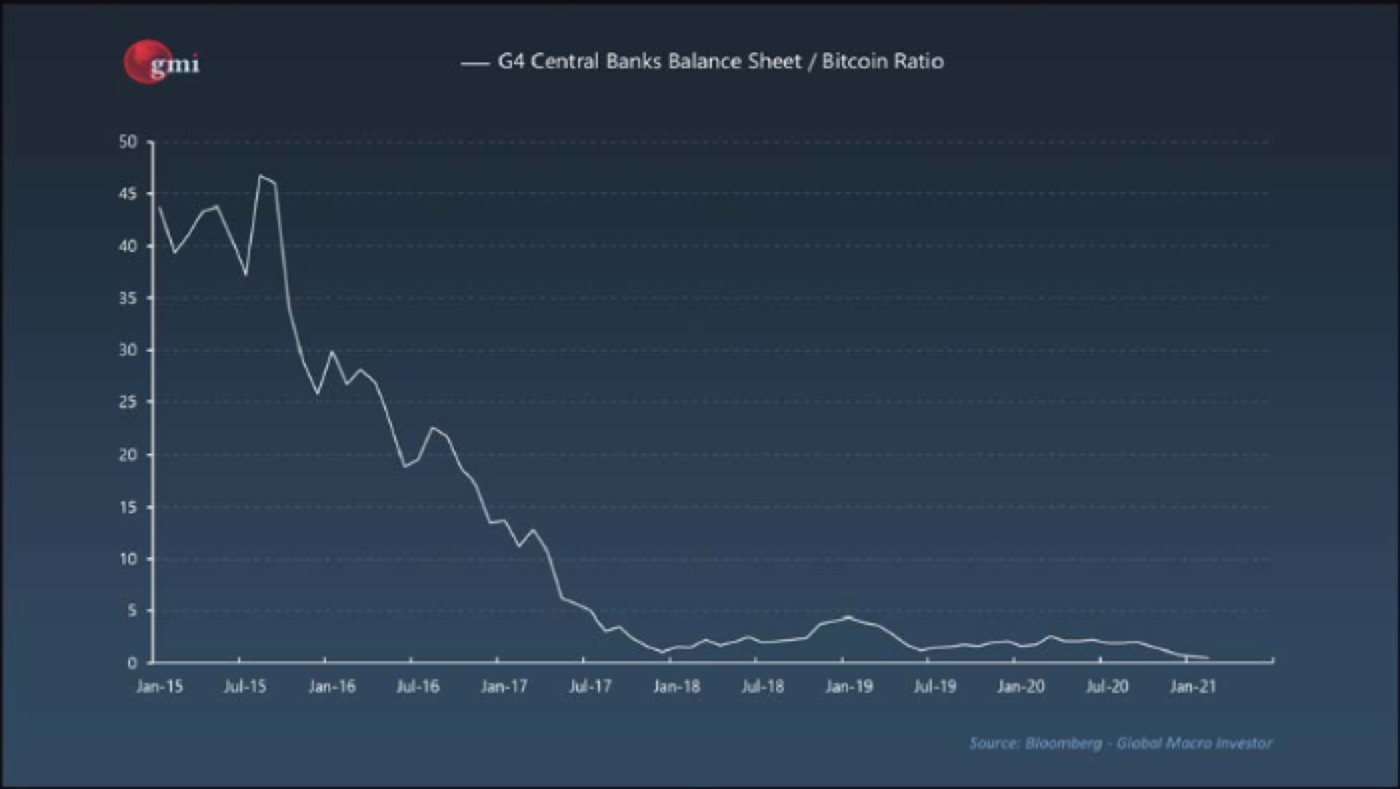
About six months ago, I started to look at all asset prices versus the Fed Balance Sheet, or the G4 Central Bank Balance Sheet. This little trick allowed me to comprehend that bitcoin was the only asset that was dramatically going to outperform this printing. It became absolutely clear that bitcoin’s performance was going to be a super-massive black hole, outperforming all assets and sucking in incredible amounts of capital.
The Chart of Truth
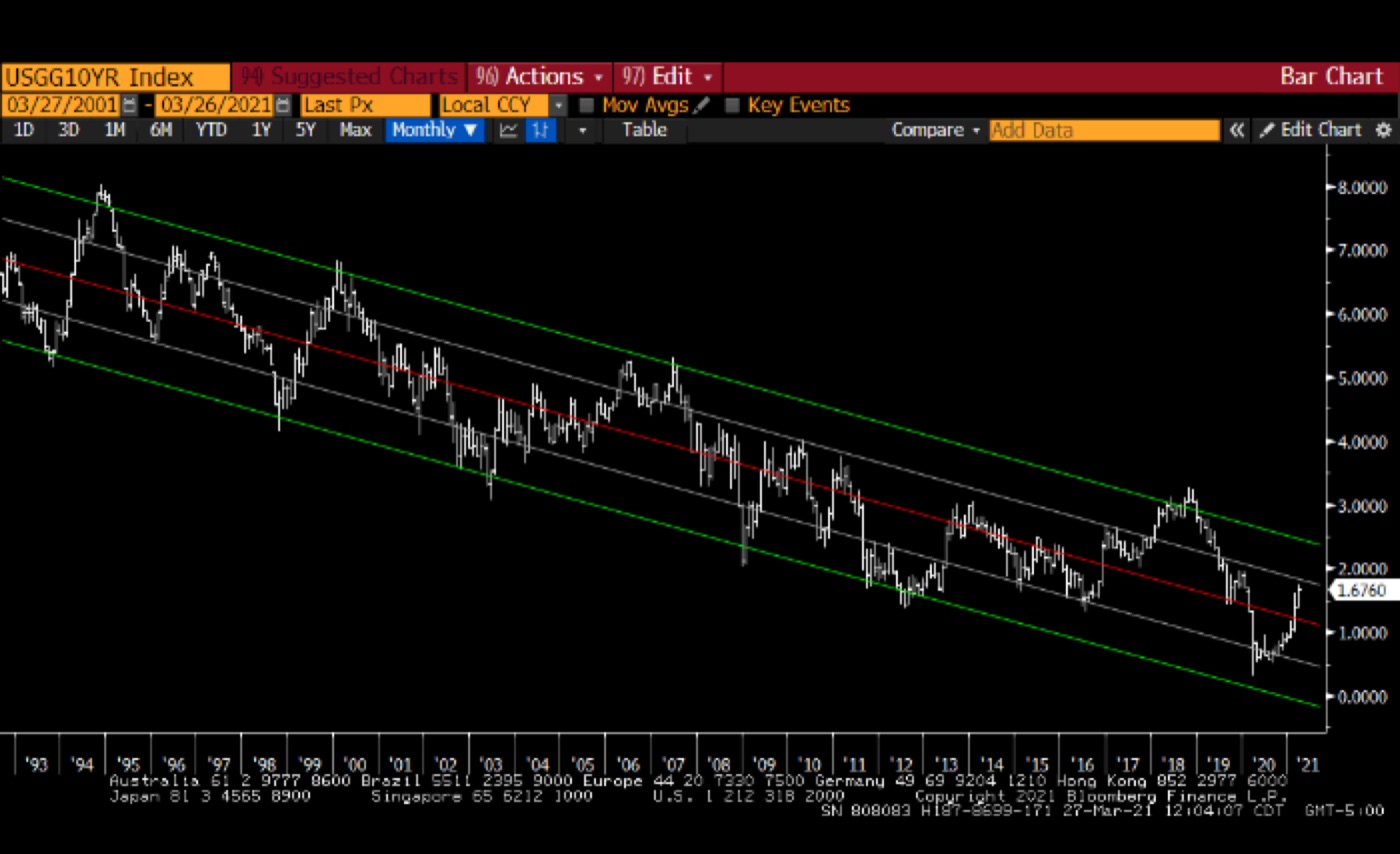
The US Dollar is 85% of all global trade, and thus US Rates are the key interest rate for the global economy. But this recession has pushed the Chart of Truth – US 10-Year Yields – very close to the end game of zero rates or less. The Fed cannot, and will not, allow the Chart of Truth to break. It would be game over. So the rate trade is more cyclical than secular at this point, and that lowers the attractiveness of the rates market, of credit, of carry. You need more and more leverage to drive the same returns.
The bubble that isn’t
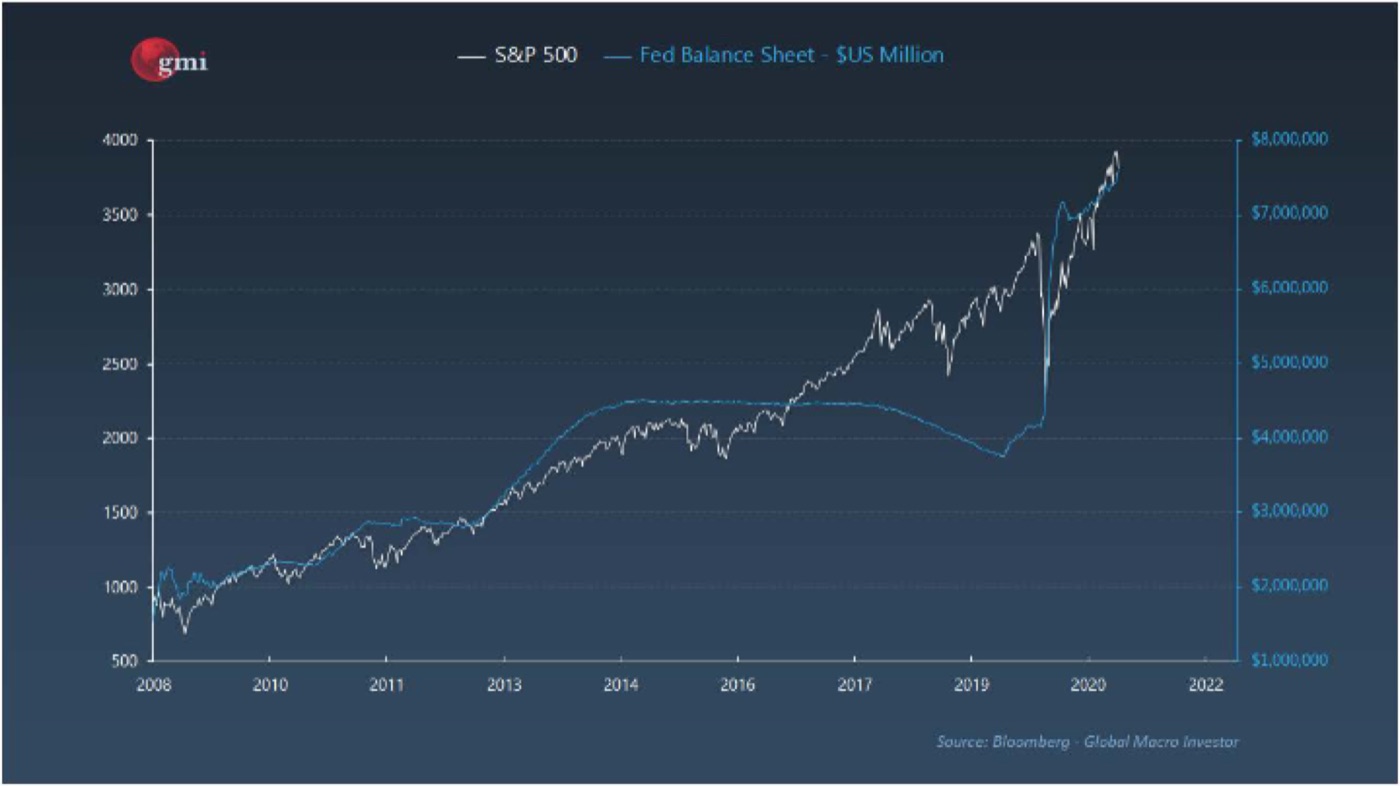
Equities had immediately gone from fair value to overvalued in six months – the fastest rise in history. Clearly, this is a bubble. Or so I initially thought. But the chart of Gold versus Equities doesn’t show anything like this level of overvaluation; gold is at its 20-year average versus equities. That struck me as very odd. And the chart of the SPX versus the Fed Balance Sheet was the chart that wouldn’t leave my mind – it is telling a different story. In Fed Balance Sheet terms, the SPX fell 80% in 2008 and has traded around its average ever since.
The moment of clarity
And then it all became clear. It is hiding in plain sight. We are seeing a devaluation of the denominator – fiat currency overall. This is why gold keeps going up versus a basket of 27 world currencies, why equities look at fair value versus gold but look insane outright, why the stock market in Fed balance sheet terms has traded sideways since 2008. If you adjust the SPX Price-to-Revenue by the Fed Balance Sheet, it actually looks undervalued, just as it should after the biggest recession on record.
Real estate is exactly the same – the rise in US prices almost exactly matches the Fed Balance Sheet growth. When you realise that gold, real estate and equities are all flat in Fed Balance Sheet terms, it becomes hard to argue against the premise that the denominator has collapsed.
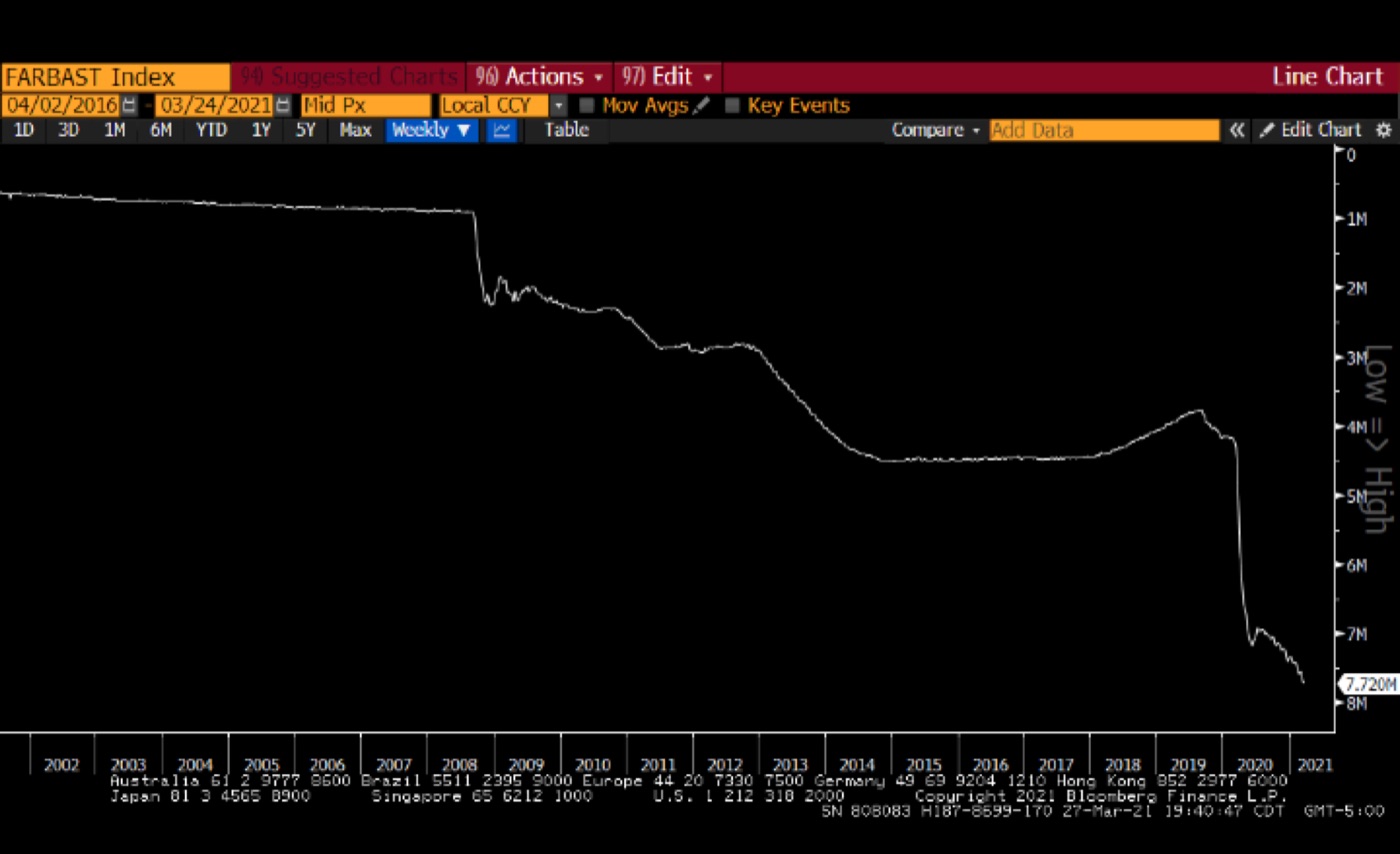
The G4 Central Bank Balance Sheets combined have risen by 619% since 2008. This is a fall in the value of fiat currency by 15.5% per annum. ALL fiat currency.
Your savings need to generate 13% to 15% just to stay flat in real, cost-of-capital terms. This is why everyone except the rich are getting poorer. No one else can own enough assets to offset the devaluation of money.
The ongoing rise of technology
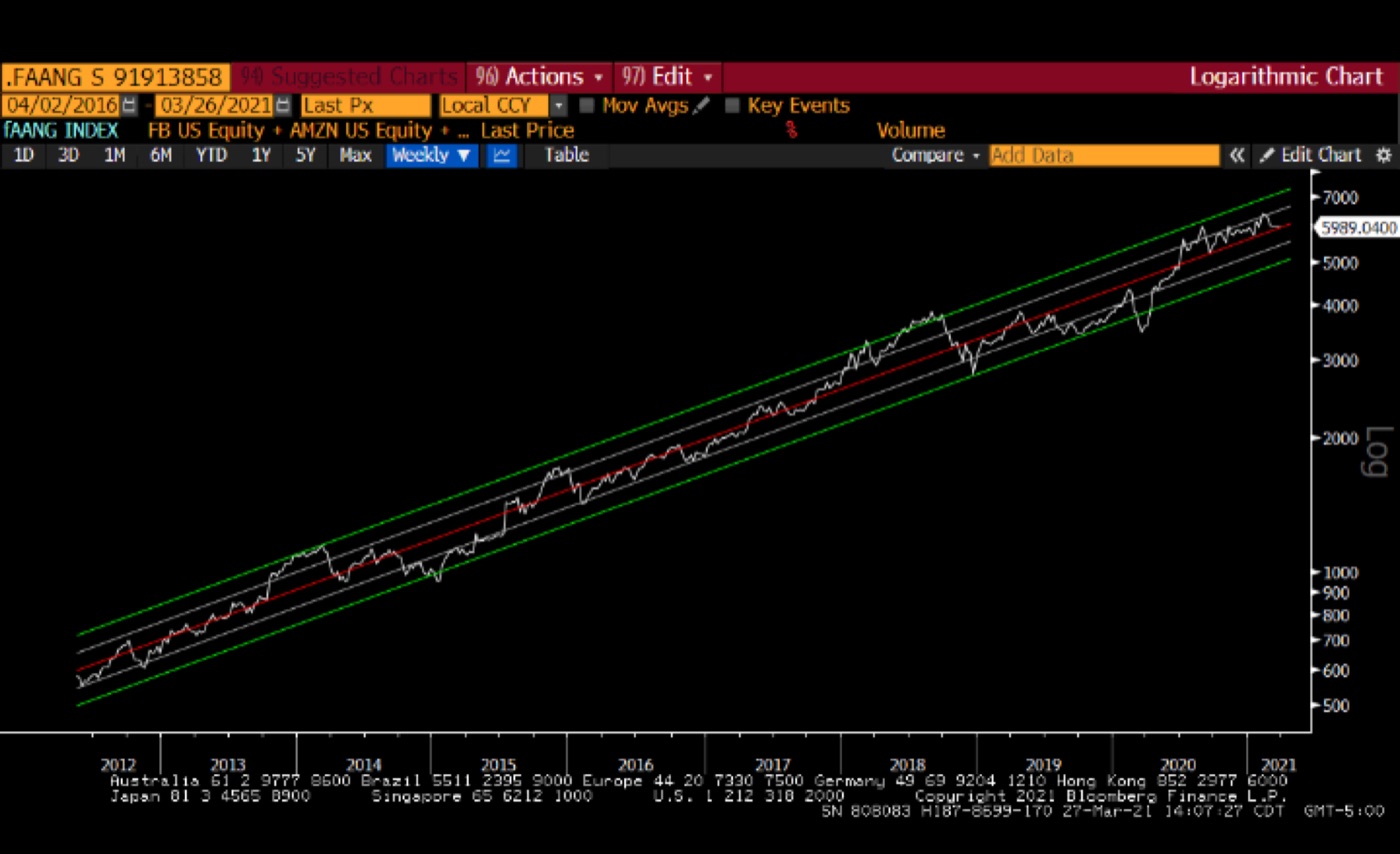
Surely this means we head into the apocalypse when all fiat collapses? Not so fast, Buster. I am getting a strong feeling this is going to play out in the exact opposite way. When I looked through the charts of assets versus the Fed balance sheet, I realised that one sector alone had offset the fall in the value of fiat: technology. The rise in the Fed Balance Sheet has disguised zombie companies – GE in balance-sheet terms is worth basically zero, AT&T is a zombie, the entire BBB equity sector is in the same boat. But the tech companies look so very different. FAANG has massively outperformed – by 304% – smashing the 15%-per-annum hurdle by another 17% per annum.
Metcalfe’s Law
My deep dive into crypto taught me something that unlocked everything else that follows: bitcoin follows network-effect adoption curves, and thus Metcalfe’s Law. Metcalfe’s Law is exponential, not linear. Something that follows an exponential trend MUST be looked at in log terms. When you look at bitcoin on a log scale, it shows an orderly trend higher – the trend of adoption over time.
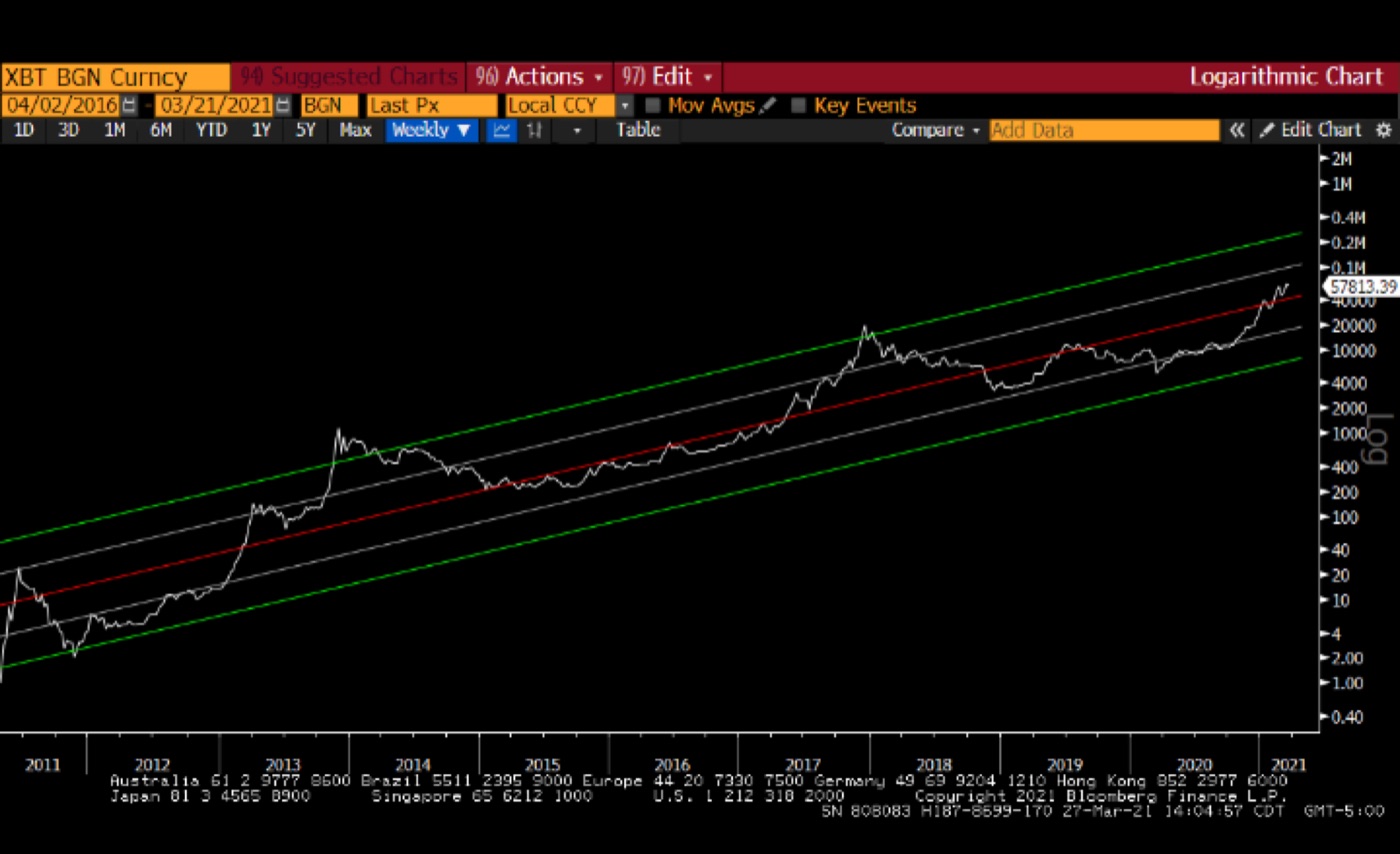
And when you look at the FAANG stocks on a linear chart – “It’s a massive bubble!” But on a log scale, a stunningly clean, perfect adoption trend. This is nothing to do with real rates or inflation. It is due to the exponential nature of these stocks, driven by network-effect adoption curves – the exact same mechanism by which Microsoft rose from the 1980s to 2000.
We are about to enter the Exponential Age
I found the final part of the jigsaw when I wrote the article about carbon. I realised that every car I see on the road, every single one, is going to be obsolete in ten to twenty years. And then suddenly, it all fell into place. We are about to enter the fastest period of change ever witnessed in the history of mankind. We are about to enter the Exponential Age. This changes everything.
Yes, the financial system is fucked – but there is a parallel financial system being built at a pace so fast that bitcoin has the fastest exponential adoption curve, and thus price curve, of any asset in all recorded history. People are migrating across to the new system at lightning speed. The Digital Asset space is superior in every way to our current system, and therefore it will attract all the capital over time. You simply cannot stop a distributed, decentralised, organic network.
To put it in perspective, the current digital asset space is worth around $1.8tn. The global bond and equity market is 100 times this, around $180tn. I think this space can do up 200x over the next twenty years as everything becomes tokenised – from real estate to art, from music to insurance, from IP to supply chains. Bitcoin as an asset is up 99,000,000,000% since 2009. In twelve years. That is what I mean by exponential speed.
The layers of the Exponential Age
The world that is coming is not just cryptocurrencies and digital assets with some tech giants and green energy. It is much bigger. The Base Infrastructure Layer – 5G and 6G, satellite WiFi, distributed and quantum computing, and green, cheap electricity – means that in the next five years we will have unlimited data, every network connected globally, and unlimited computing, all improving exponentially each year.
On top of that sits the Productivity Layer – AI, robotics, 3D printing, autonomous vehicles. All of it exponential in adoption; it destroys everything that went before it, and every single business has to adopt it. There is no choice. Above that is the Digital Value Layer – the layer of crypto – the digital exchange and recorded ownership of everything, from insurance contracts to Universal Basic Income. And the Human Layer – wearables, biotech, the Internet of Things, and the Metaverse, which in the next twenty years will create an economy as large as the existing global economy, layered on top of it.
Remember, it took roughly only two months to crack the mRNA code for the Covid vaccine. Two months. Once you add the ability to compute vast amounts of data and the rise of robotics, AI and 3D printing, things are about to change ridiculously fast for mankind.
The investment opportunity
Macro investing was traditionally driven by the superior returns of the downcycle. With interest rates pegged and currencies range-bound, that downcycle opportunity in bonds, credit and equities has gone. Equities will become a larger part of the mix – traditionally not a good macro instrument, but the world has changed.
A simple log chart does a better job of assessing valuations – but a crucial point everyone misses: exponential trends only correct to their long-term exponential moving average, which is always rising, not to the mean or linear trend. Amazon, once it went exponential, only ever tested its 100-week exponential moving average. Bitcoin, more volatile, tends to revert to its 250-week moving average.
Changing the framework
I have not changed my macro framework in sixteen years of writing GMI, and it has worked very well. Over time I will transition to the new framework while keeping the old framework of business-cycle analysis for added protection. A lot of the new framework was already in my existing one – bitcoin, EM, India – but the big difference will be a shift towards buy-and-hold in equities that express the big-picture view, with periodic hedging, and less focus on rates, FX and commodities.
The Exponential Age happens to be the biggest period of change in world history. This is not about just one exponential trend such as social media, but a HUGE number of exponential trends all interacting at the exact same time.
This is somewhat like the Industrial Revolution – which lasted eighty years – but in a much more compressed time period. The current financial system ends with a fizzle and not with a bang, as increasingly people migrate across to the new world.
All said and done, I am excited to move into an exponential upside world. Mankind has literally never seen anything like this in such a concentrated period of time.
Membership
Read GMI for yourself.
Twenty-one years of calls like this one, and the positioning each month. Explore the research, the platform and the membership options.
Explore membershipRequest preview access