Best of GMI · the ten canonical essays · 05 of 10
THE DOLLAR THESIS · 2016
The Dollar Wrecking Ball.
The RMB has to realign. The money rushes to the dollar. And in the end, the dollar rises alone – the last major shoe to drop.
FROM THE GMI ARCHIVE · EXCERPT
EXCERPTED FROM THE GMI 2016 THINK PIECE:
MONTHLY PUBLICATION · JANUARY 2016
THE 2016 THINK PIECE · GMI MONTHLY · JANUARY 2016
The Dollar Wrecking Ball
A rising dollar will play a major part in the global economic outcome – and no one will escape unscathed.
It was a year all about the dollar for me.
My short-term risk portfolio was the outsized winner in 2015. I had 9 winners out of 11, with EEM shorts being the single most profitable, but I also had great returns in shorting the RMB and selling various currencies against the dollar. The dollar was the axis everything else turned on – and I think it stays that way.
The dollar is still in a clear uptrend
Let’s take a look at the FX markets. The DXY is still in a clear uptrend and is poised to break out above 100. DeMark suggests that there are another five months to go before we need to fear any truly major correction – never forgetting that there has never been a correction of more than 10% in any dollar bull market, ever.
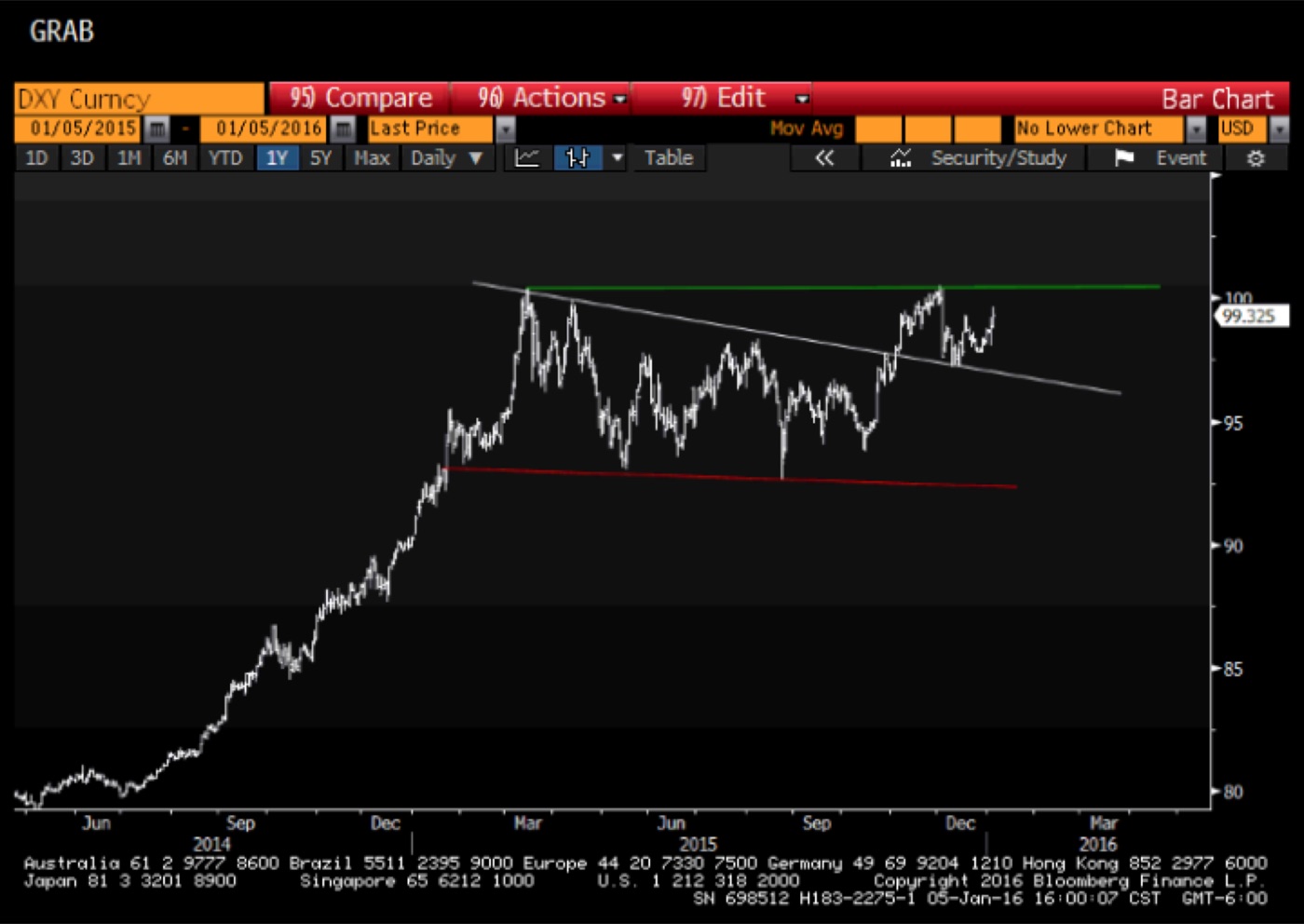
The Euro has no DeMark counts of note and should bust through the lows. The Yen is wildly unclear. The Aussie is ready to fall again. The whole majors complex looks like it still has further to go – up for the dollar, down for everyone else.
Chinese RMB devaluation
One of the things I got very right in 2015 was the start of the Chinese currency devaluation. I think the Chinese currency has some way to devalue in 2016. Who knows where it could fall to, considering the potential carry trade unwind and capital flight? It could fall as far as 50%.
Best-, not worst-case scenario
But let’s not look at the worst-case scenario – let’s understand what happens in the case of an orderly devaluation. How far does it need to fall to be in line with the other Asian currencies? The RMB has wildly outperformed the Japanese Yen, which is one of the key fault lines in the global macro picture. To get back into the previous range, it would need to fall around 25%.
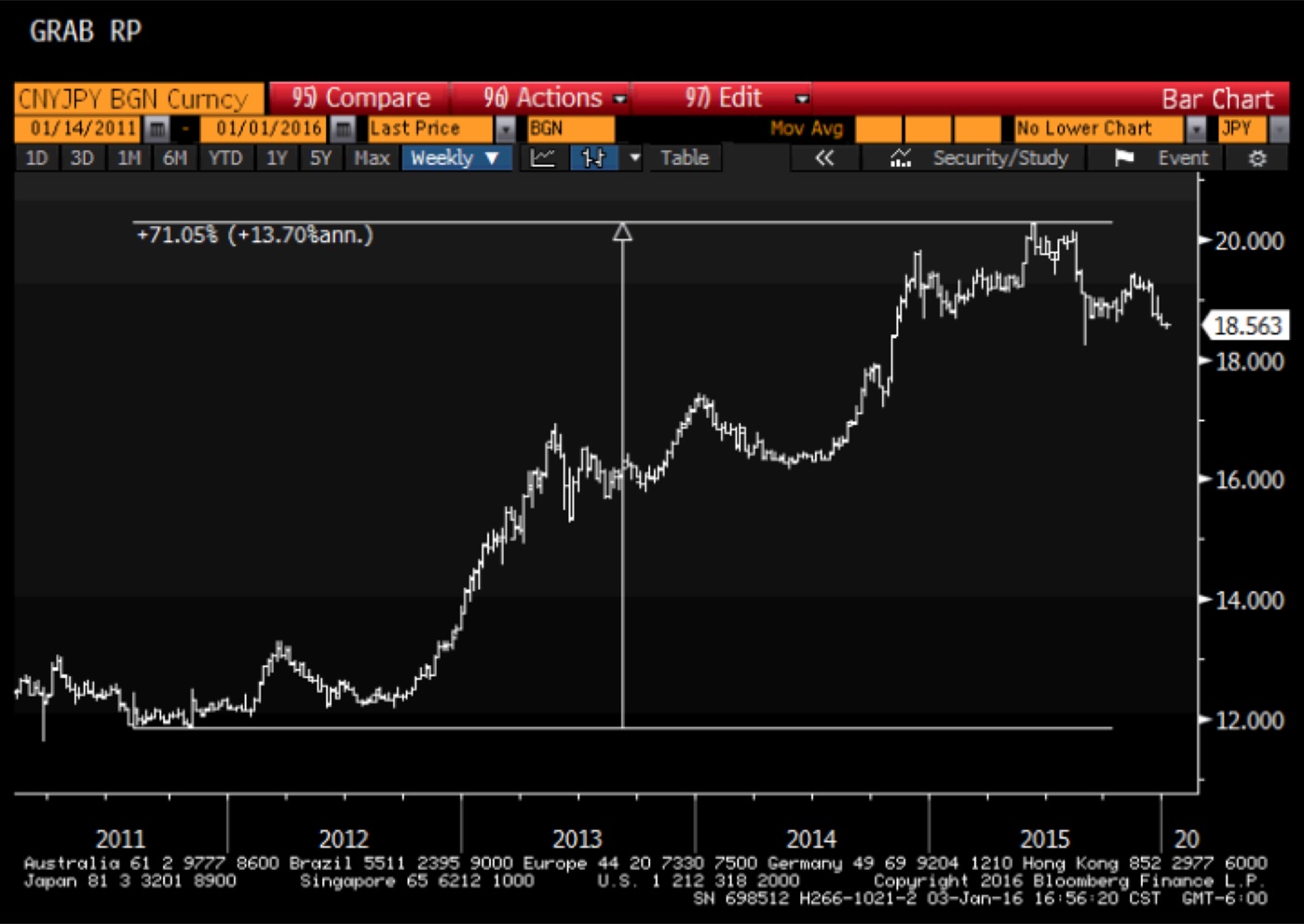
Versus the Korean Won, the RMB has only outperformed by some 17%. Versus the Taiwanese Dollar it is around 20%, and versus the Singapore Dollar around 20% as well. To rebalance with the stronger Asian currencies, we would need to see falls of around 10%. But the move against the developed-market currencies is far larger.
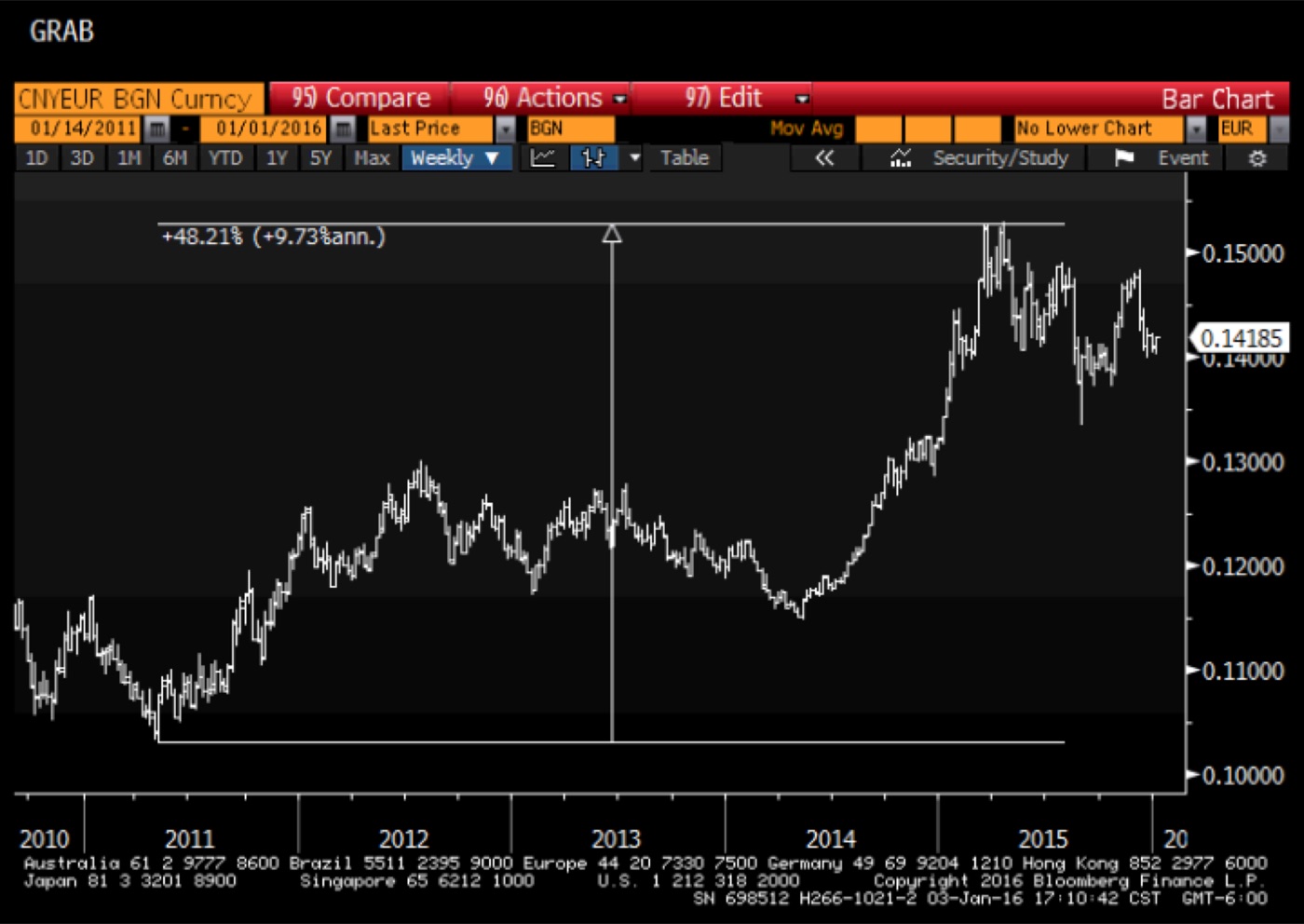
Finally, if we use the REER from the BIS, we see that the RMB has risen some 60% since 2005 and 37% since 2010. Thus, if we snapshot the price of the dollar here, I think that the RMB most likely needs a fall of 15% to 20% to realign with the other global currencies.
What’s next?
But the key question is what happens after that? Is this a positive or negative event? Well, firstly, a 20% fall would bring the ADXY down by 8.2% (the RMB has a 41% weighting), to the cheapest levels since the early 2000s.
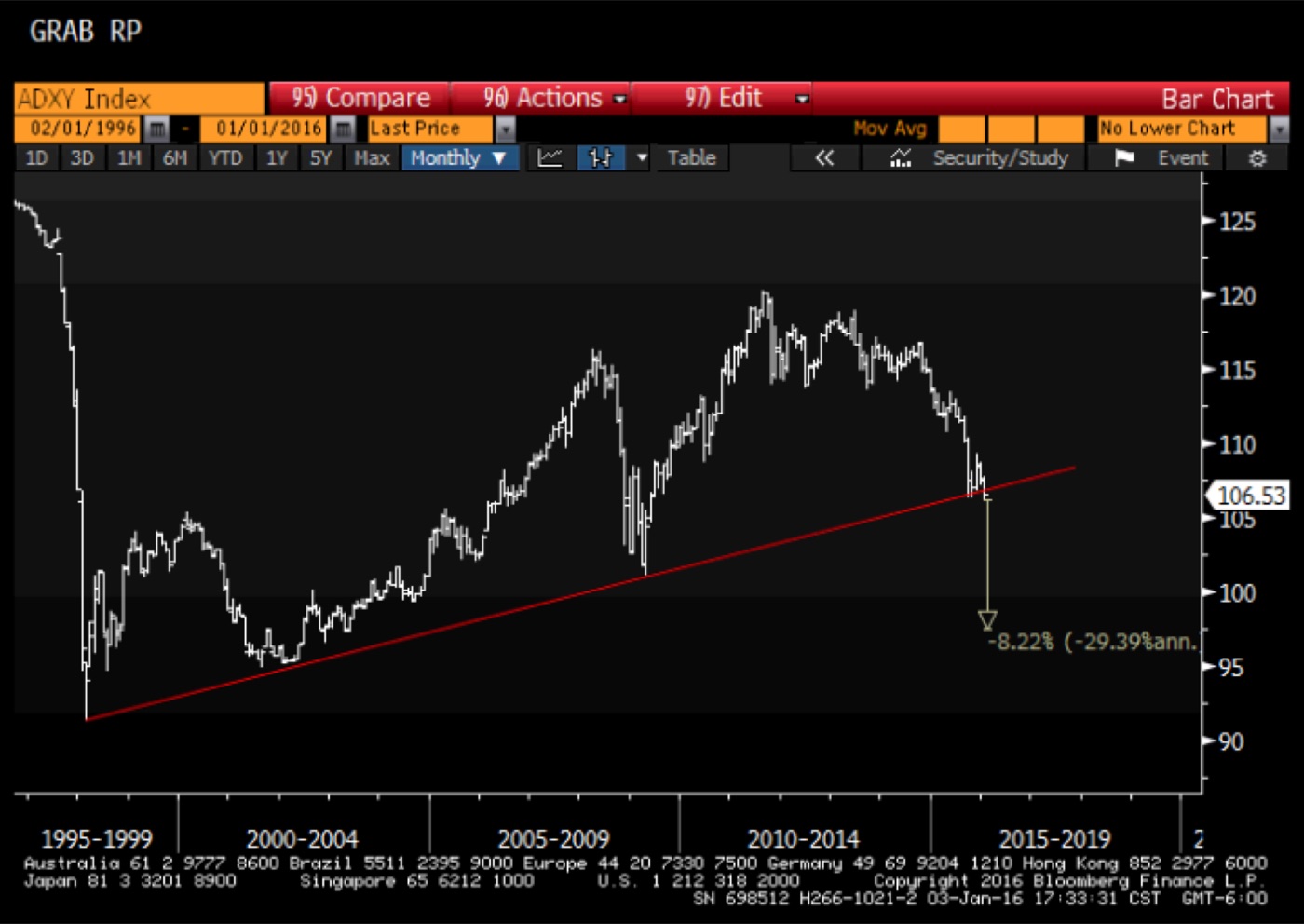
I also think that the rush of money into the USD would push the US Dollar much higher, causing the entire Asian complex to trade somewhat lower and bringing the ADXY down to the low 90s – unwinding a huge amount of the global carry trade and causing some pretty large debt-related issues and pain in the banking sector globally.
This would clearly lead to more weakness in other currencies and a resultant fall in commodity prices, along with some real financial problems around the world, especially in commodity-producing nations. However, Asian markets – which would likely fall in that scenario – will be cheap, and many distressed opportunities will arise. Trade with China should pick up again, but with less dollar revenues; and considering the lower reliance on commodities, the impact will be much less on global GDP.
The dollar will stand alone
But after that, the world will see all the major currencies aligned, except the Dollar. They can all fall together – or, to be clearer, the dollar will revalue higher versus the rest of the world.
My view has always been that, in the end, the dollar will rise alone and will severely damage the US, which will be the last major shoe to drop.
A rising dollar will play a major part in the global economic outcome – it has already pushed the world into the second-weakest export growth since 1958. There is going to be some tremendous pain in all of these dramatic shifts, and no one will escape unscathed.
But at the end of it, once the carry trade has been wiped out and the dollar has had to be managed lower in a Plaza-style Accord, China will have had to take some serious pain and see a wave of defaults on dollar-funded debts – and the world will be much more balanced. The only question I can’t really answer is how bad it will get first, and what other bubbles will get unwound.
I can’t imagine the US stock market will get away without losing 50% at some point and, with a looming pensions’ crisis, I struggle to believe it will bounce back hard this time. Eventually, all the real money will be made in the East and in Africa, as the GMI Monsoon Region’s superior demographics and debt profile offer a once-in-a-lifetime opportunity.
Let’s just keep our focus on the RMB and the continuing dollar revaluation. It’s a long way to get to – there are just too many banana skins to potentially slip on.
Membership
Read GMI for yourself.
Twenty-one years of calls like this one, and the positioning each month. Explore the research, the platform and the membership options.
Explore membershipRequest preview access