Best of GMI · the ten canonical essays · 02 of 10
THE FINANCIAL CRISIS · 2007
The GFC Call.
An old-fashioned credit cycle, spreading well beyond housing – written into the shorts on the very morning the crunch began.
FROM THE GMI ARCHIVE · EXCERPTS
EXCERPTED FROM TWO AUGUST 2007 ISSUES OF GMI:
MONTHLY · AUGUST 2007
UPDATE · 9 AUGUST 2007
PART ONE
A Summer of Discontent
The macro thesis: this was never just housing, and it was never going to stay contained.
I don’t think I need to spend too much time going over the credit issues of the last month. As you know it is something we have been expecting and I am sure you have all been bombarded with analysis on it.
It’s an old-fashioned credit cycle…
Just for clarification’s sake I want to briefly summarise where I think we are. Firstly, I think this is an old-fashioned credit cycle that has almost always been a feature of the bottom part of the economic cycle. Low rates cause excessive borrowing, lenders become less selective, rates go up and eventually the burden is too much. This is age-old stuff.
… which is not confined only to housing…
Secondly, I think you have to ignore all the talk about containment. Those days have passed. The credit issues are spreading everywhere. The weakest link always fails first and that was housing. Everyone said that housing was an isolated event and that only sub-prime would suffer. Clearly this is not correct on either count.
The building companies have made it clear that the problems have spread to all types of borrowers, not only the very worst; and the debt market for private equity has almost entirely dried up and has nothing to do with housing. Lending conditions across the board are going to be tightened and the effects will be far reaching. That much is crystal clear.
… but will hit the economy…
Thirdly, I think that the US is almost certainly going to hit zero growth by September. That was my projection from many months ago (March, I believe) and I see no reason to change my mind. Economic indicators are all weakening again after the one-quarter inventory-rebuild pop of Q2. I think they will get worse.
… and the equity market too
Finally, I think that we are likely to witness a major top in US stocks and an old-fashioned bear market. I doubt it will be anything catastrophic but it should wipe 15% to 20% off the S&P in the next six months.
Known unknowns…
What we know we don’t know is what will happen to other markets. Market participants fully expect that the US might see some rocky times, but are convinced that it won’t spill over into emerging markets. I don’t think things will be that neat. I think of it as an inverse Asian crisis. When the Asian crisis happened everyone got hit, only Asia more so. This time I think the US will get hit – its economy flirting with mild recession – while Asia’s economies will only slow a bit.
We also know that we don’t know what will happen to the carry trade. People suggest that the Turkish Lira, Brazilian Real etc. won’t suffer, but the marked appreciation in the JPY suggests that we might see everyone forced out of these too. The carry trade is, in a nutshell, in complete denial that there could be currency risk. Frequently denials of risk like this tend to backfire badly when you least expect it.
Things I want to know (unknown unknowns)…
The thing that intrigues me the most is how bond yields are going to react to a US recession, and what will happen to inflation. My guess is that we might see another flirt with deflation in the West (but not in Asia) but it is too early to tell. What will be very instructive is what happens to interest rates and bond yields at the bottom of this cycle. Will they make new lows, or bottom out at a higher low?
Why do I care? Well, if bond yields bottom out above the previous low then that would signal to me the end of the entire bond bull market from 1982. If that happens we will have to start to use a different framework for the years ahead.
Things you need to know (not-known knowns)
Perspective is a key thing here: credit spreads are still very tight. The move is barely noticeable outside of the more toxic CDO stuff and the other credit rubbish. However, credit spreads are very tied to the economic cycle and they usually get much worse. It looks like we’ve got another 50% or so upside in these spreads. Bad first, better later.
The amount of money globally that is going to have to bear a horrid re-mark-to-market is enormous. Not only are a few hedge funds going to get into trouble (there seems to be a new one every day à la 1998/9) but possibly a bank or two…
So now you know that credit spreads are going to go wider, you also need to realise that equity volatility is massively correlated to credit spreads. Equity volatility goes up when the market goes down. Fact. Credit spreads are going wider and therefore equity volatility is going higher.
It is all the same trade
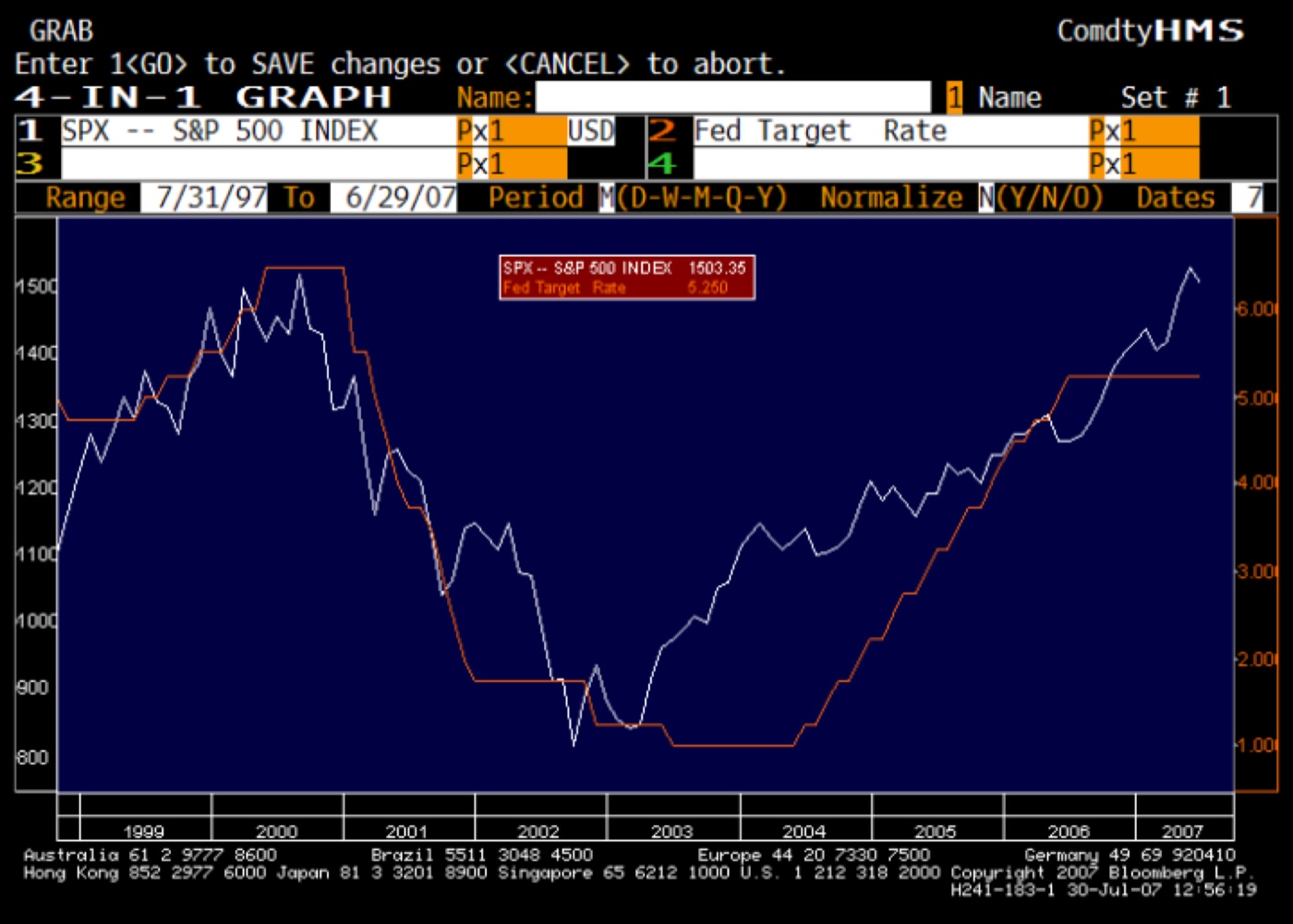
You also need to know that carry trades like EUR/CHF are in fact the same trade as being long stocks. EUR/JPY is also the same trade. Swap spreads are too. And for those of you hoping for an instant, happy decoupling of emerging markets – they are entirely correlated. The Nikkei over the last ten years has only been driven by US rates, and US rates are the only thing driving US stocks too. Makes you think a bit, doesn’t it?
Banks
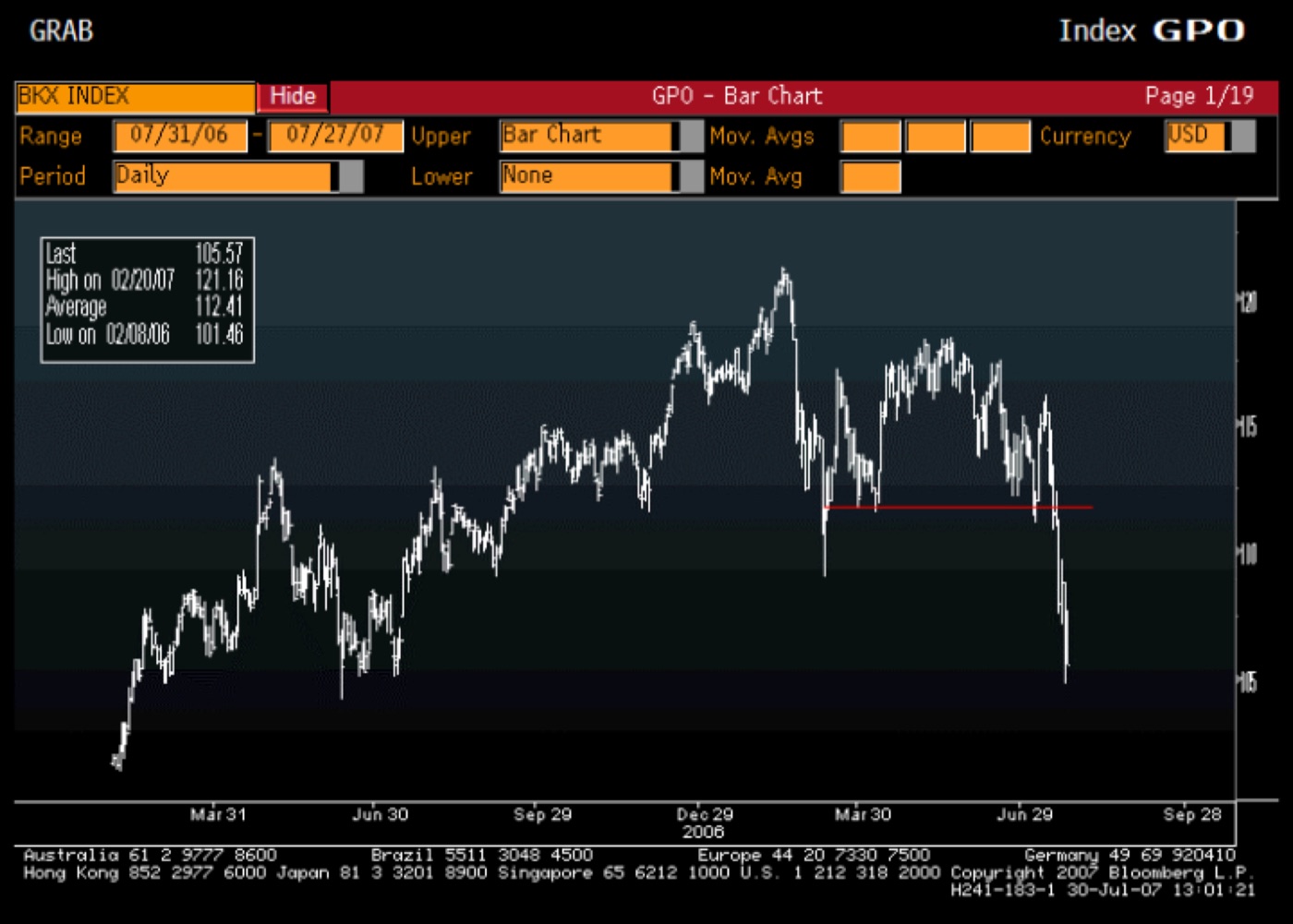
We put out a “short US banks” recommendation a couple of weeks ago, luckily before the worst of the market falls. I highlighted that the BKX and the S&P Regional Banks index had formed GMI crash patterns. These seem to be playing out with a vengeance.
The BKX is now in freefall. I am sure we will soon see a bounce, but essentially we are headed much, much lower. These kinds of banking issues take some time to sort out. In 1989 to 1991, for example, Citibank fell more than 50% during the S&L crisis and the accompanying credit spasms. It would be odd for the banks to get only a small hit when we know that so much more trouble is to come.
PART TWO
You Can’t Bank on a Quiet Summer
Part II. The thesis turned into trades – written the morning the ECB opened the liquidity window.
I think I have been pretty clear in my outline as to what to expect out of risk markets and the US economy. I have been expecting a bounce in stocks that should hit the 50% to 61.8% retracement in the SPX. That happened yesterday. According to my GMI Magic Bear Market Predictor pattern, I would expect the bounce to last around a week or longer.
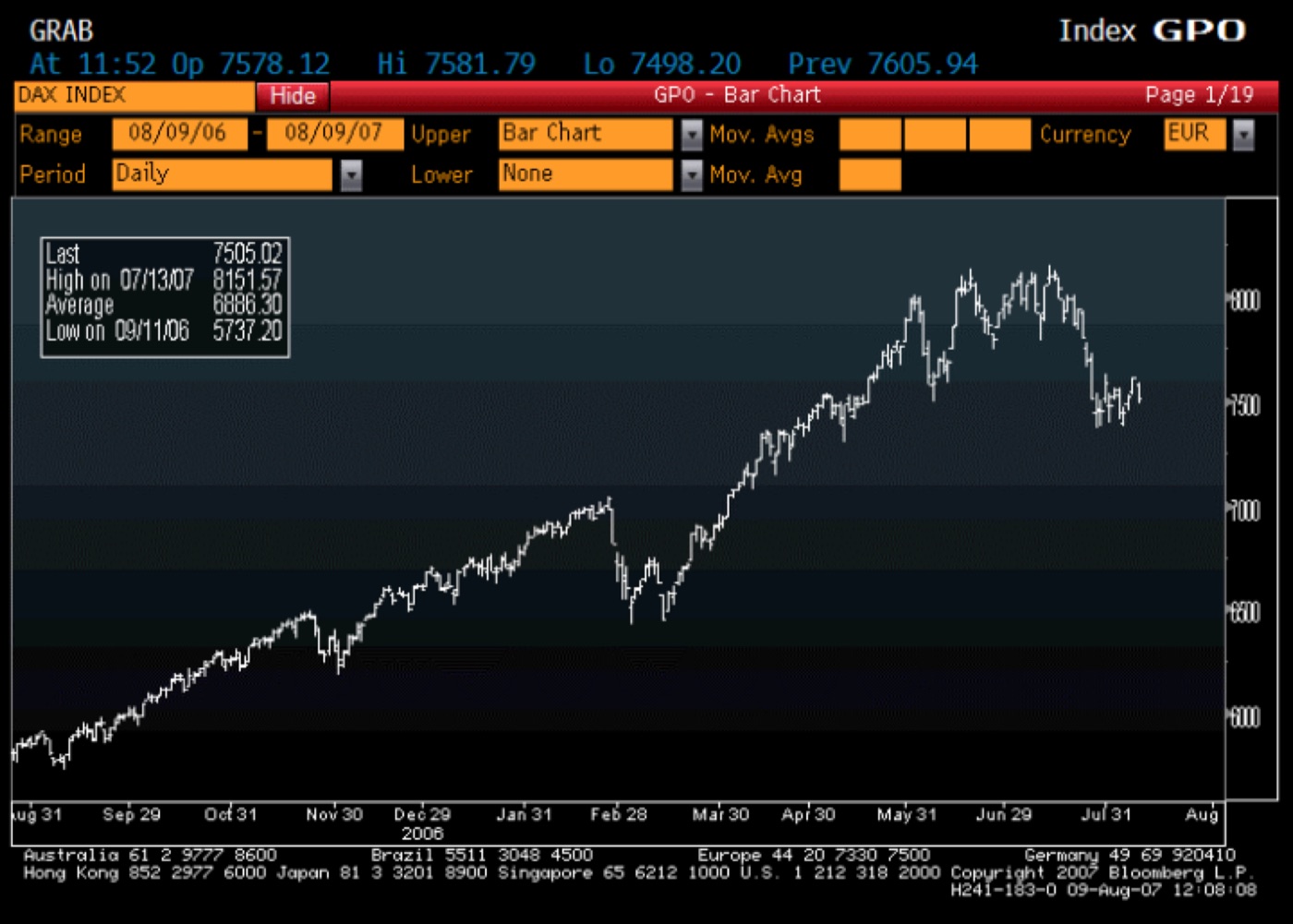
When you take a look at the Dax chart you can see that things are different. It fell for around 10 days and now has traded sideways for 10 days. That is good enough for me to expect the next leg to happen soon. As ever I may be early… but that’s a risk I am prepared to take.
Something is amiss…
Before I show you the chart I just want to draw your attention to the biggest move in overnight rates in eight years. The ECB has had to open the liquidity window this morning to free up the markets. Something is amiss in Europe and I get a very big feeling that a bank of reasonable size is in trouble (or it may even be more than one bank). This kind of thing doesn’t happen without reason.
I am also receiving a lot of feedback from friends and subscribers at European banks who tell me that things are getting bad, both from a treasury point of view and from a prop trading point of view. Everything is falling apart and the profit downgrades to come are going to be significant. Back to the Dax… I want to short it. It looks awful and seems to be at the edge of a precipice. End of story.
More banks… more trouble… more shorts…
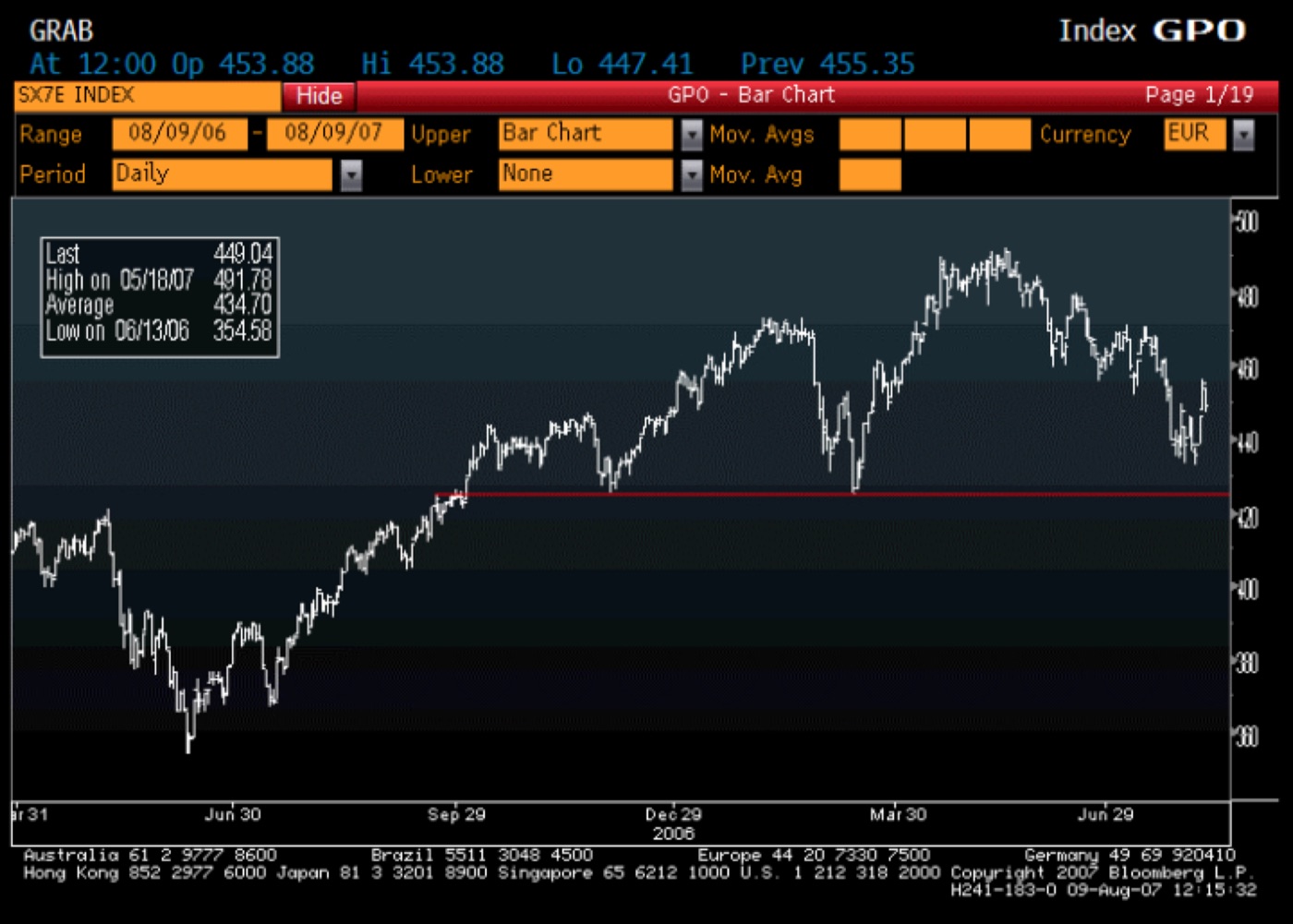
Following the same line of thought I also want to short the European banks. I will short both the SX7P and the SX7E (thus including UK banks but placing a double short in European banks). There is something badly wrong in Europe. I think smaller banks are chock full of CDO-style debts plus enormous other credit spread exposure, and no one has taken the mark-to-market. Additionally, they have large carry-style prop books and big hedge fund investments… all bad.
The SX7P essentially includes the UK banks. We know that the UK housing story is an accident waiting to happen and lending standards have been somewhat slack. I might as well be short both indices.
Down under… another bank could go belly up…
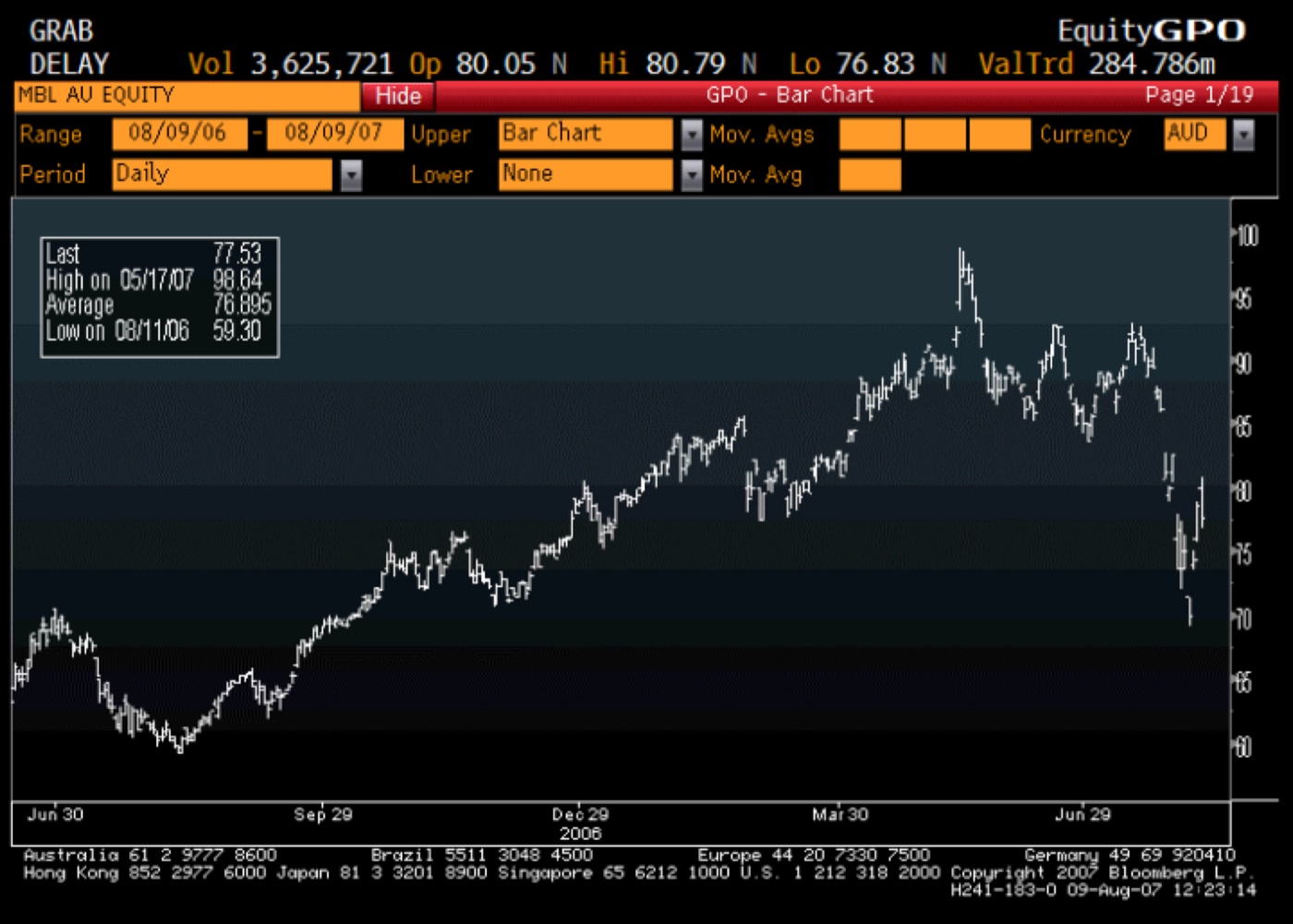
Another stock that has been flashing warning signals to me for some time is Macquarie Bank. These guys are the current “smartest guys in the room.” Forgive me, but when that kind of talk circulates around a firm built on cheap debt financing it makes me concerned. When they outbid every other firm in the world for all kinds of infrastructure assets by a big margin, and claim that their competitive edge is the “proprietary model,” I begin to laugh out loud. When I can see that all kinds of liquidity is being sucked from the system and Aussie rates are rising, and knowing that their model requires refinancing, I get all shaky and realise I have to be short.
The problem is that everyone else is short. Well, they were… but after the cheeky little rally we’ve just had I’d guess that all the weak hands are now out and it’s a clean trade. The chart looks UGLY. Perfect crash pattern… short any bounce.
Carry is going out of the window…
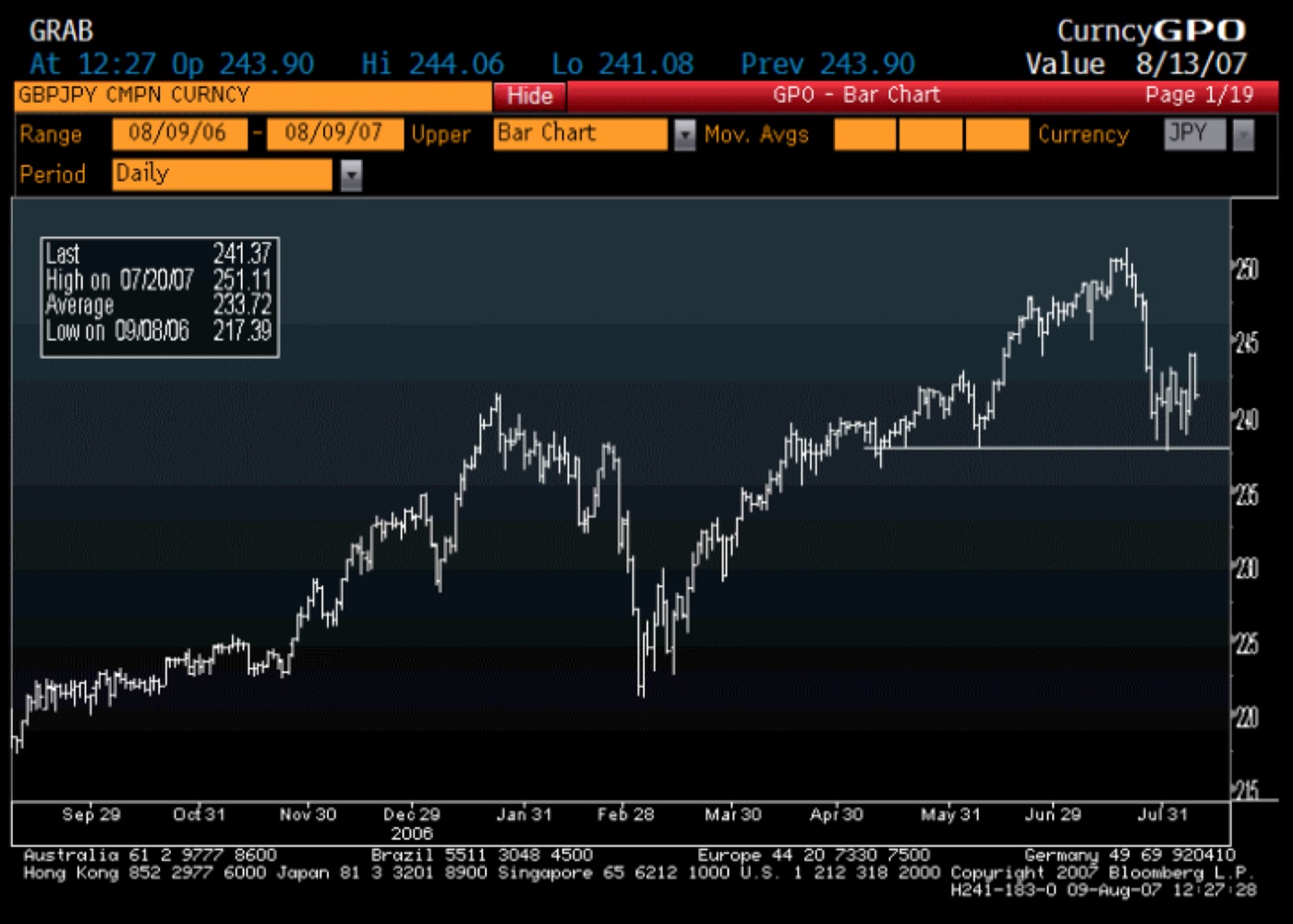
And just to round it all off… if there is a liquidity crunch forming then carry trades are going to get it in the neck. The king of G7 FX carry trades has been GBP/JPY. This too has formed a crash pattern. I wish to short it.
Also, as I’m getting a tad nervous about things, I am going to take profits in my 2-Yr JGB short. We have made good money. I’ll take it off the table… I expect a monster of a fixed income rally. All of you guys worrying about inflation are barking up the wrong tree.
Membership
Read GMI for yourself.
Twenty-one years of calls like this one, and the positioning each month. Explore the research, the platform and the membership options.
Explore membershipRequest preview access